

News
Problem / Challenge
A common misconception is that a steel-lined concrete asset is un-inspectable from the steel surface. In traditional high-frequency NDT, the steel-air or steel-concrete interface causes a significant impedance mismatch, leading to a series of repeat echoes that mask any signal that returns from the deeper concrete structure. Traditional hammer-tap methods are typically used, but this leads to unreliable estimates of the asset condition.
Here we look at the case of a hydro plant penstock as shown in Figure 1.

Figure 1. Cross-section of the simulated penstock model showing the steel liner, concrete fill, and cast-in ribs and anchors. The Pundit device is placed on the inner diameter steel surface.
A steel liner is bonded to reinforced concrete, with ribs and anchors cast into the concrete to mechanically tie the two materials together. Voids behind the liner, whether from poor initial grouting or from deterioration over time, reduce the support the concrete provides to the steel and can lead to buckling under the pressure the structure is designed to carry.
Solution
Our simulations show that using low frequency ultrasonic arrays is feasible and that they penetrate effectively in concrete and reduce the repeat echoes within the steel plate that would otherwise obscure signals from deeper features.
For this study, we modeled a Screening Eagle PD8050 16‑channel device operating at 50 kHz in Salvus to assess what void dimension can be resolved.
The simulation mesh captures the geometry of all interior features so that their individual contributions to the recorded wavefield can be identified. Figure 2 shows two cases. One with a void in the concrete and one without. You can see how the wavefield changes between the two. What is interesting is that there are no repeat echoes from the steel. At this wavelength, the steel behaves more like a filter than a reflector.

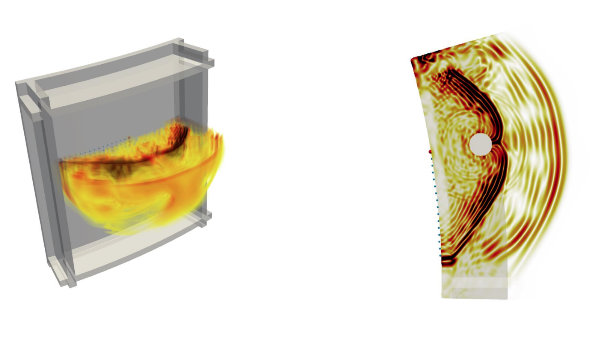
Figure 2: When introducing a spherical void into the concrete, most of the wavefront passes past the void, but a small amount is reflected.
Because the wavelength is so large relative to the steel liner thickness, the data is remarkably clean. The 3D snapshots show a single wavefront passing through the steel into the concrete. The steel liner here acts as a filter.
Our simulations can easily adapt to different sizes and shapes of voids, so that an idea of inspection sensitivity can be determined. It was also observed that a disbond between the steel liner and concrete caused a total reflection of sound and this is easily detected in the results.
Conclusion
The conclusion of this study was that with simulation supporting the data analysis, delaminations produce strong, well-defined reflections that are readily distinguishable from the background response of the intact interface. the simulation results indicate that a measurements taken from the steel liner can provide information about the bond condition at the interface, the presence of voids within the concrete, and the positions of the structural ribs and anchors, all from a device that requires no special coupling beyond contact with the steel surface.


